Resolution as Attention for Efficient Agent Memory Perception

Siqi Xiang1 Zhipeng Xu2 Shengrui Liu1 Zulong Chen2 Chunyan Miao1 Shijian Lu1*

1Nanyang Technological University2Alibaba Group*Corresponding author

Effective agent memory depends not only on what is preserved, but on how finely each past interaction is perceived. Resolution as Attention (RAA) uses visual resolution as the agent's attention over its interaction history, keeping critical interactions sharp and spending fewer visual tokens on the rest.

Drag the scale to see what the agent perceives and how many visual tokens it costs.

ClawGym-Bench Task 150, interaction H1
0.92scale
96visual tokens
69%of full cost

At Step 12, Resolution as Attention perceived this manuscript excerpt at 0.92 and a less relevant error message at 0.13. Visual tokens are counted on the 32 px patch grid of Qwen-3.8-27B.

Perception as a dimension of agent memory

Every one knows what attention is. It is the taking possession by the mind, in clear and vivid form, of one out of what seem several simultaneously possible objects or trains of thought. … It implies withdrawal from some things in order to deal effectively with others.

William James, The Principles of Psychology, 1890

The granularity at which an agent perceives each past interaction should vary across interactions and evolve as the task progresses. Resolution as Attention renders each interaction as an image and scales its resolution according to its relevance to the upcoming decision.
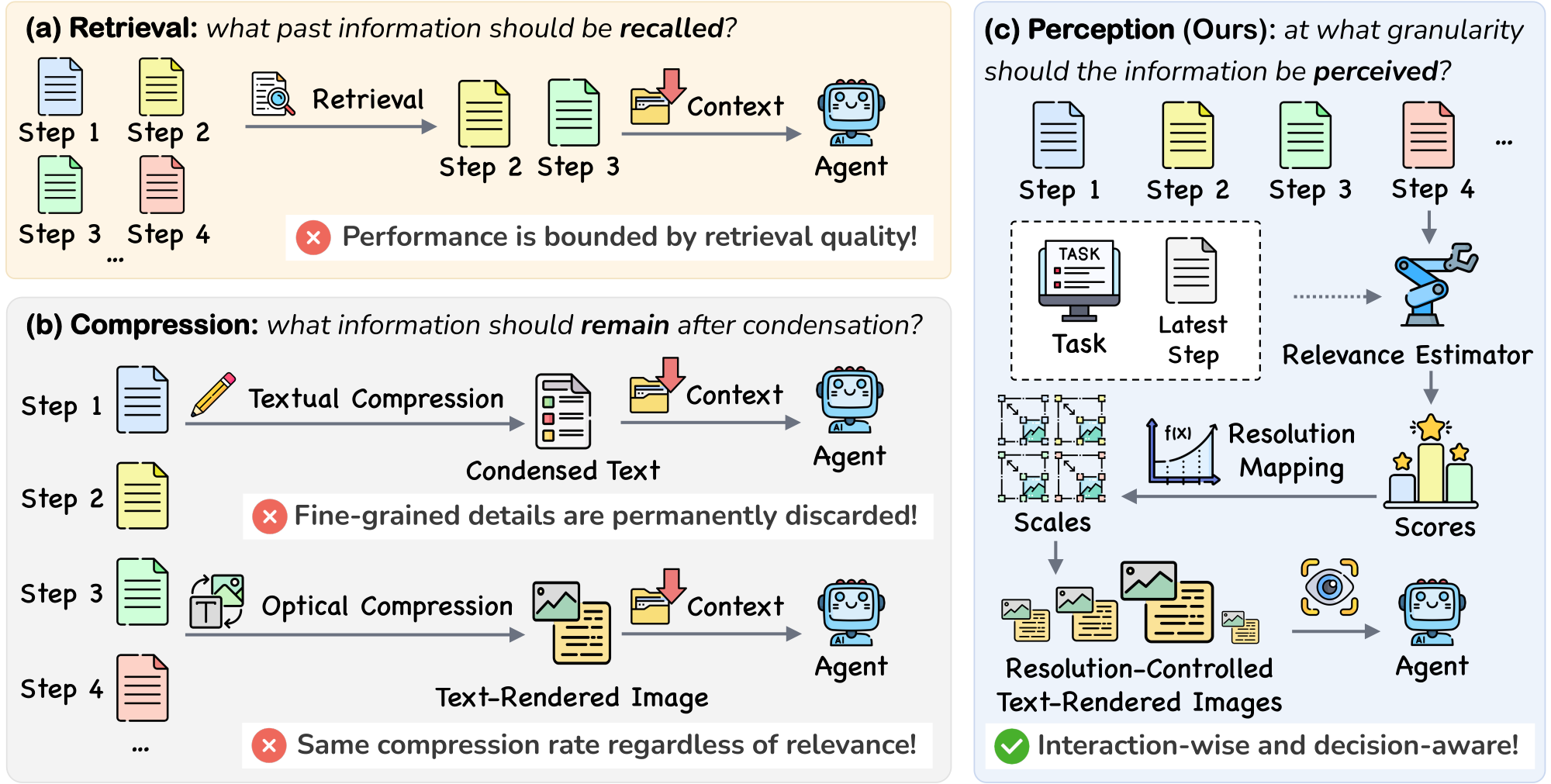
Three panels comparing memory approaches. Retrieval recalls a few past steps into the context. Textual and optical compression condense every step the same way. Resolution as Attention renders each step as an image and gives it a resolution scaled by its relevance to the upcoming decision.
Retrieval is bounded by what it recalls. Textual compression discards fine-grained details, and optical compression applies the same rate regardless of relevance. Resolution as Attention perceives each interaction at a resolution scaled by its relevance to the upcoming decision.

Resolution as Attention
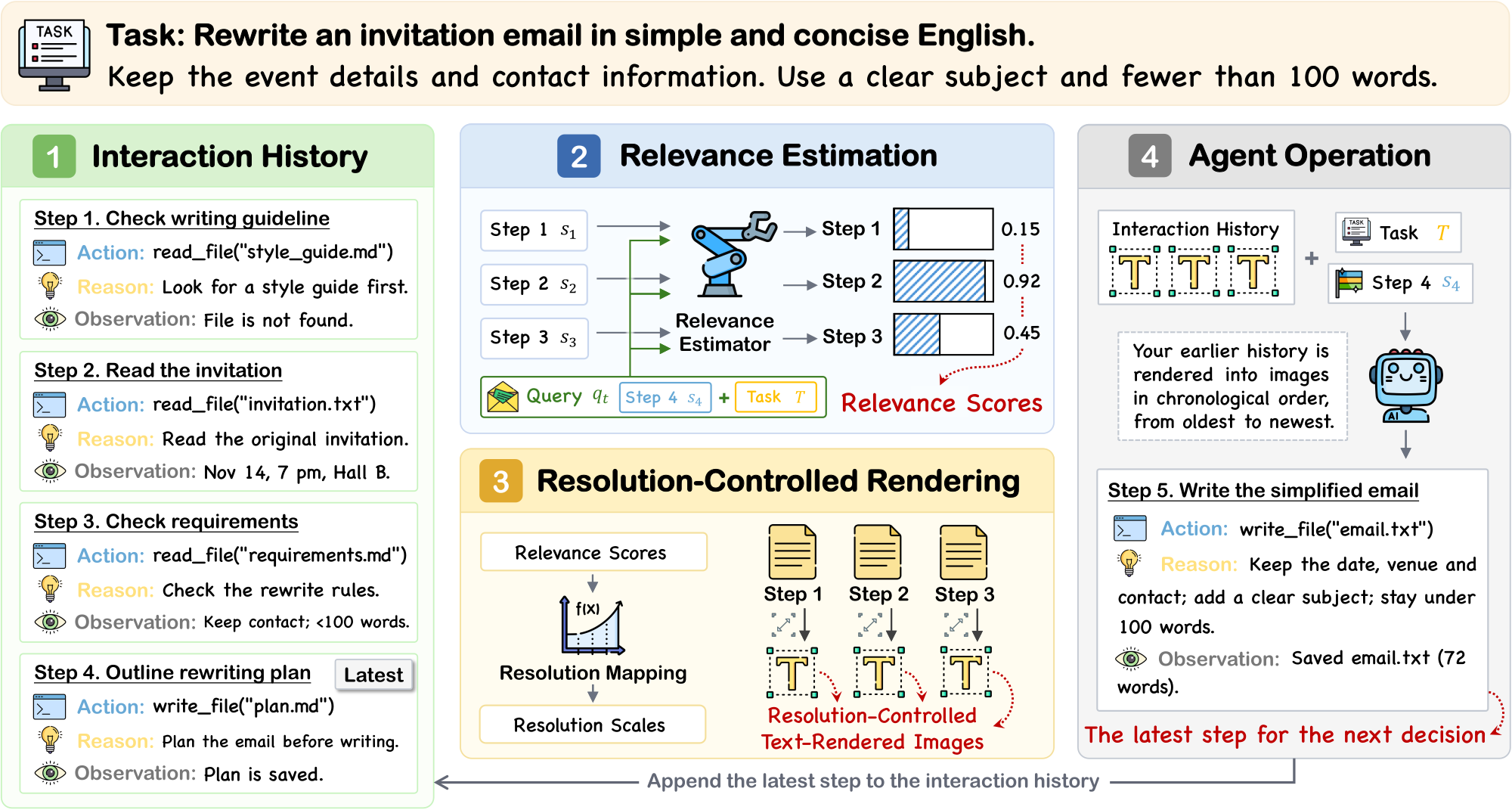
Overview of Resolution as Attention. Each past interaction in the history is scored by a relevance estimator against the task and the latest step. A resolution mapping turns the scores into scales, and each interaction is rendered as an image at its scale before the agent perceives it.

Relevance estimation

A 0.6B estimator, fine-tuned from Qwen3-Reranker, scores each past interaction against the query formed from the task and the latest interaction.

Resolution-controlled rendering

A learnable sigmoid maps each score to a scale. Each interaction is rendered once as a canonical image and resized to that scale before the agent perceives it.

Two-stage training

The estimator first learns from teacher relevance ratings, then is calibrated with reinforcement learning to keep the agent's decisions with fewer visual tokens. The agent stays frozen throughout.

Results

Average score against history tokens per task for each method
fewer history tokens per task than Vanilla

A layer on top of existing memory management

Resolution as Attention determines how memory is perceived, and therefore complements methods that determine what memory is retained. Adding it to summarization, retrieval and masking further cuts their token consumption by 22.5% to 54.1%, with no loss in score. Results with Qwen-3.8-27B.

Without RAAWith RAA

What the agent sees

Case Study 1. The agent writes six social posts that quote a manuscript exactly. At Step 12 it checks the posts against their sources. The manuscript text it must quote stays sharp. A more recent error message about chapter IDs, less relevant to this check, shrinks to a few patches.
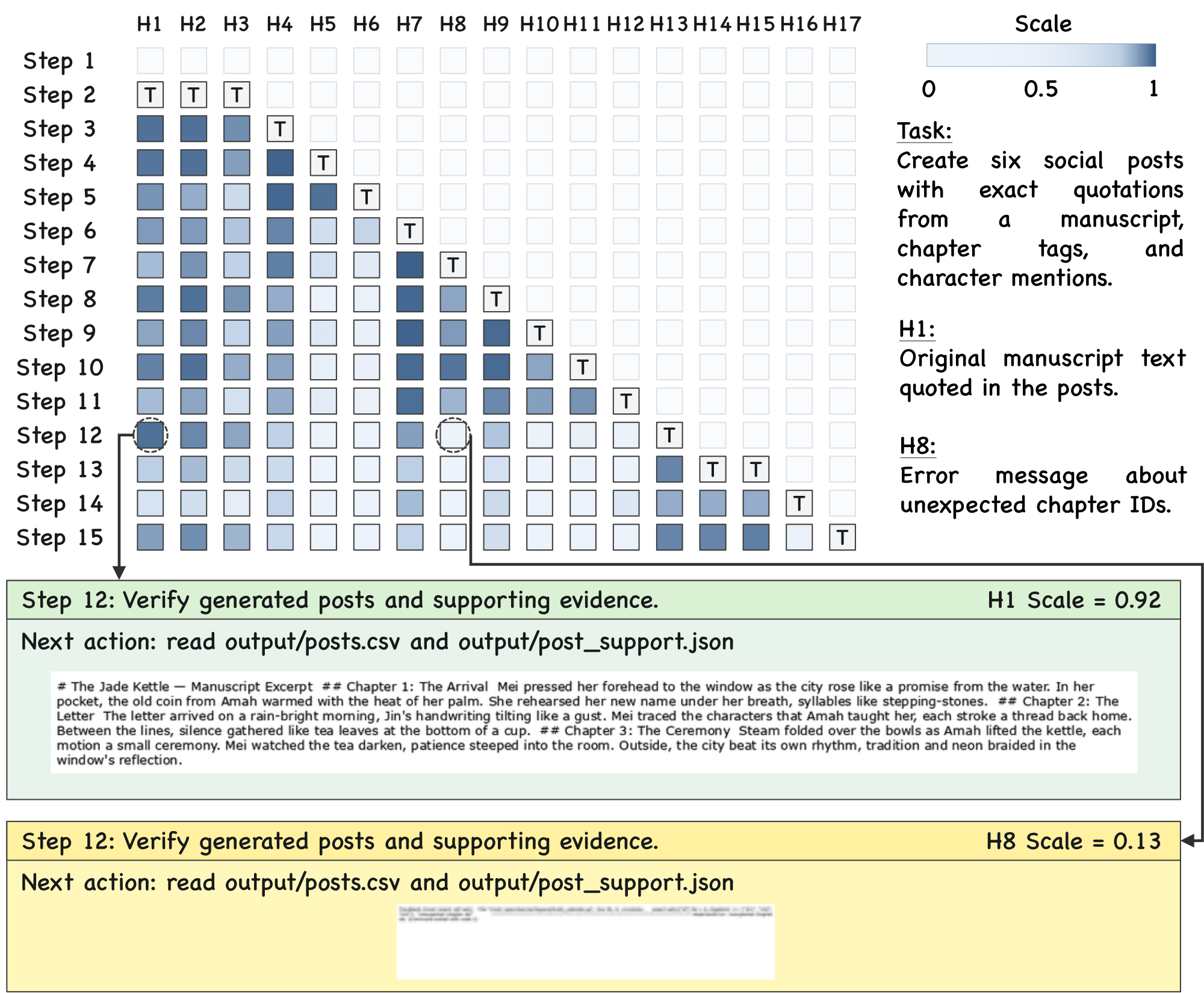
Heatmap of resolution scales for 17 past interactions over 15 steps of Task 150, with the Step 12 rendering of H1 at scale 0.92 and H8 at scale 0.13.
Scales across all 15 steps of ClawGym-Bench Task 150. Each row denotes one step and each column represents one past interaction. T marks the latest round.

Case Study 2. The agent builds a screening pipeline for RC filter prototypes and then updates the lab notes. While it runs the pipeline, the lab notes fade to a coarse scale. Once it turns to verifying them, they come back into focus.
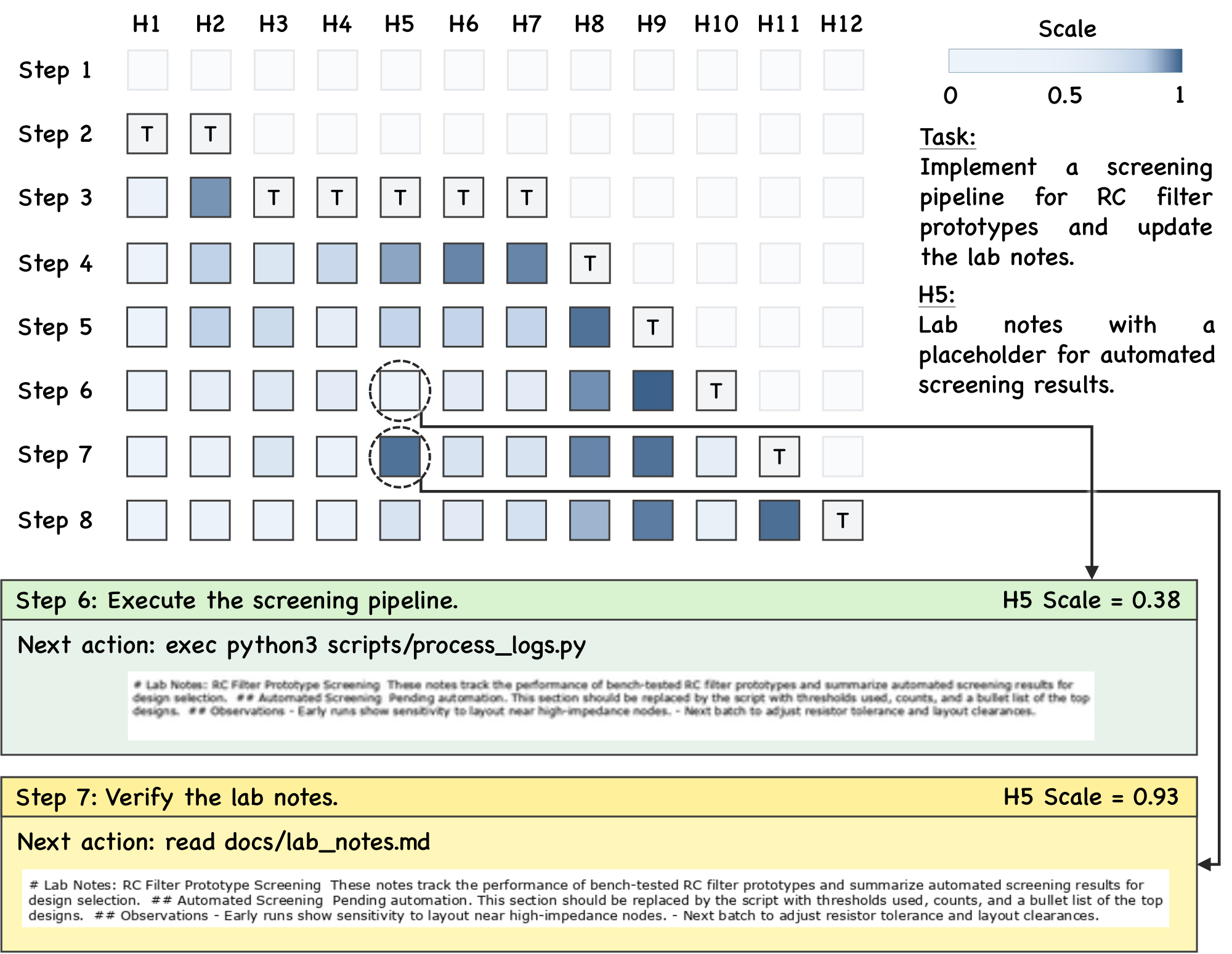
Heatmap of resolution scales for Task 42. The lab notes in H5 drop to scale 0.38 while the agent runs a screening pipeline and return to 0.93 when the agent verifies the lab notes.
Scales across all 8 steps of ClawGym-Bench Task 42. Each row denotes one step and each column represents one past interaction. T marks the latest round.

BibTeX

@article{xiang2026resolution,
  title   = {Resolution as Attention for Efficient Agent Memory Perception},
  author  = {Xiang, Siqi and Xu, Zhipeng and Liu, Shengrui and Chen, Zulong and Miao, Chunyan and Lu, Shijian},
  journal = {arXiv preprint arXiv:2611.24422},
  year    = {2026},
  url     = {https://arxiv.org/abs/2611.24422}
}